
Fulton Release Date Systems
Start by separating county jail, state prison, federal prison, and pretrial detention. A Fulton jail record can show a booking, days in custody, release date, and release type. It cannot calculate a later GDC or BOP release after transfer. GDC administers Georgia prison sentence dates. The Parole Board controls parole decisions. BOP maintains federal release dates.
| Custody | First source | Date meaning |
|---|---|---|
| Fulton pretrial | Jail and court | Often no fixed date |
| County sentence | Jail and sentencing order | Sentence less lawful credit |
| Georgia prison | GDC offender record | Tentative, maximum, or sentence date |
| Parole review | Parole Board | TPM is not a release date |
| Federal prison | BOP locator | Federal projected or past release |
A transfer is not release to the community. If Fulton data says “Transferred to DOC,” “Return To State Prison,” or another-agency transfer, move to the named system. The county release date marks the end of that local custody stage only.
Find Fulton Projected Release Dates
For someone in the Fulton jail, check the sheriff’s current-inmate search, then the court case. Charges, bond, a release order, sentencing, and credit for time served can change the date. For a state prisoner, use the GDC Find an Offender form. GDC says its tool can provide facility location, release date, and charges. Search by GDC ID when known, or match name results with another identifier.
- Identify county, state, or federal custody.
- Match the person with an agency identifier.
- Read status, facility, and date fields together.
- Check the sentencing court for later orders and jail credit.
- Check parole only when the sentence is eligible.
- Use a narrow records request when public fields remain unclear.
For a federal inmate, do not apply Georgia credit rules. BOP warns that release dates can be recalculated for First Step Act credits. When a BOP release date is in the past and no facility is shown, BOP says the person is no longer in BOP custody. Another supervision or custody system may still apply.
Georgia Prison Date Fields
Georgia rules define several terms that sound alike. Sentence Begin Date is the effective start after appropriate jail credit and court instructions. Sentence End Date reflects the maximum sentence from that start, with non-running time and earned credits considered. Tentative Release Date is the maximum term less earned time and may change. Maximum Release Date is the full-sentence endpoint exclusive of parole decisions, where one exists.
A Conditional Transfer Date concerns possible conditional transfer after earned time. A Tentative Parole Month, or TPM, is the Board’s tentative month for final parole review. It is not a release date. Misconduct, new sentences, jail credit, court documents, or unmet programs can change the timeline. Life and death sentences do not have an ordinary maximum release date under the cited definition.
Fulton Earned Time and Credit
Fulton county jail computation has two distinct legal inputs. O.C.G.A. Section 42-4-7 authorizes earned-time allowances for county inmates within statutory limits and permits specified work-detail credit. O.C.G.A. Section 17-10-11 provides credit for time served upon conviction. Earned time rewards qualifying custody conduct or work. Jail credit counts prior confinement toward the sentence. They should not be treated as the same calculation.
A Fulton release marked “Time Served” may make sense only after reading the sentencing entry and jail history together. Weeks already spent in custody can leave little or no term after sentencing. The Share Fulton dataset can show DaysinCustody and ReleaseType, but the court disposition explains how the sentence and credit produced that result. No universal local formula was established in the research.
County earned time is also different from bond. A person released on bond has not completed a jail sentence through earned credit. The criminal case continues unless the court record says otherwise. A probation release may begin supervision instead of ending the sentence.
GDC Work Incentive Credits
O.C.G.A. Section 42-5-101 allows GDC work incentive credits for academic or vocational attainments, satisfactory work, and compliance with behavior standards. GDC reports credits to the Parole Board. The Board considers them in the final parole decision, and GDC may recommend applying credits to advance an established tentative parole release date.
These credits can affect a state release estimate. They do not guarantee parole and do not turn a TPM into an actual release date. The Board may grant, deny, defer, postpone, or alter parole before release. A state sentence date must therefore be checked again when the planned date nears.
Fulton Parole Timing Rules
Most parole-eligible Georgia inmates are statutorily eligible after one-third of the prison term, but the Board says few receive parole at first eligibility. Certain serious violent felony sentences, fourth-or-more felony recidivists, and life without parole are excluded under the Board’s summary. Life-sentence review also changes with the offense and date.
Georgia does not reduce every sentence to one simple “85 percent” rule. Official categories, offense date, sentence type, earned credit, parole eligibility, and Board decisions control. Use the Board’s parole process and TPM tools for the sentence at issue. If parole is granted, DCS may supervise the person after release; the Fulton post-release supervision guide explains that later stage. Record the date of every parole lookup because a decision can change before release.
Why Fulton Release Dates Change
Later facts can move a projected date. Some changes reduce time, while others extend custody or alter the destination. Compare each change with the agency and court record instead of relying on an old saved result.
| Change | Possible effect |
|---|---|
| Jail credit | Counts qualifying prior confinement |
| Earned or work credit | May reduce an eligible term or affect parole timing |
| Discipline | May reduce credit or delay a tentative date |
| New sentence | Changes sentence computation |
| Court order | May change bond, sentence, or release authority |
| Detainer | May cause transfer rather than community release |
A detainer is a request from another authority to hold or transfer a person. The date on one record may still be correct even when a second agency immediately takes custody. Use careful wording such as “released from Fulton custody” or “no longer in GDC custody” until the destination is confirmed.
GDC Release Date Help
The GDC questions page directs users to Find an Offender for facility and release-date information. The official view shown below supports the Georgia state-prison route.
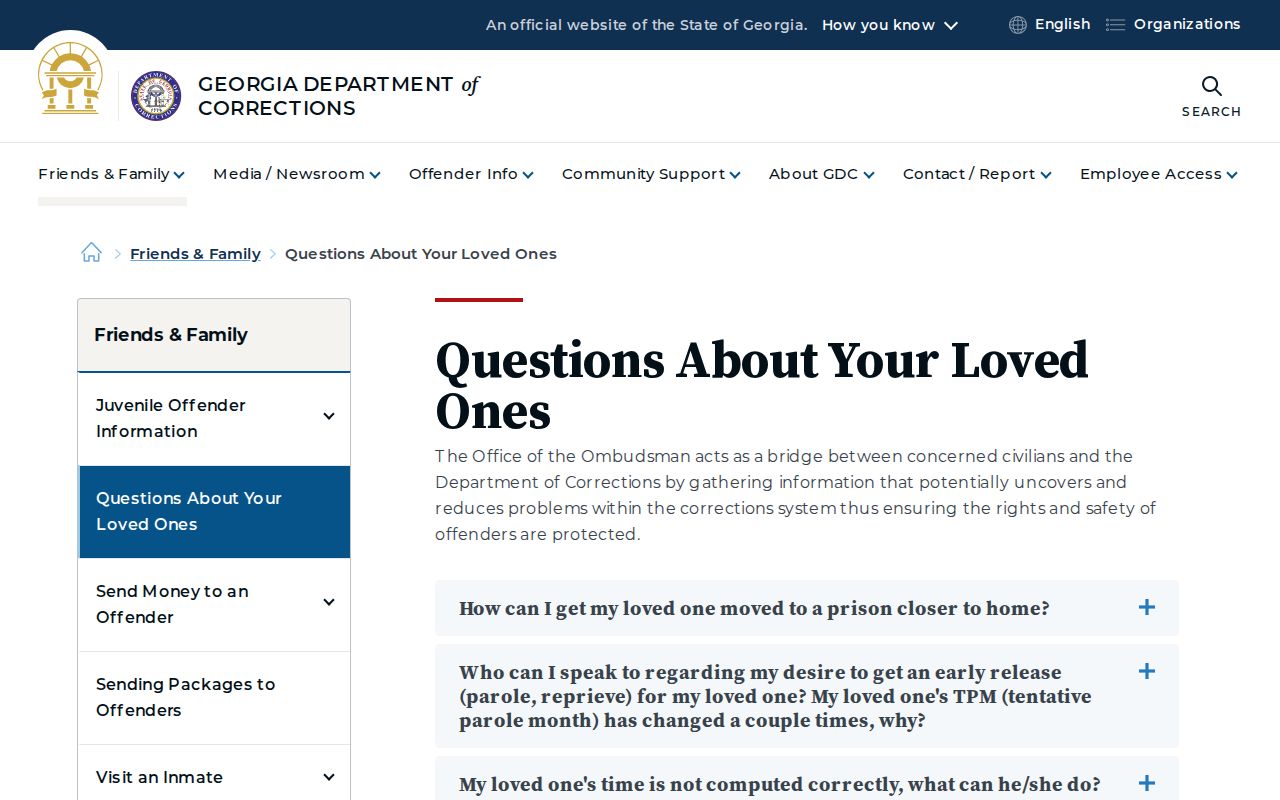
If the result is missing or unclear, submit a focused request through the GDC open-records portal. Ask for public release or discharge confirmation and public sentence fields. GDC says institutional and central office files are confidential under O.C.G.A. Section 42-5-36, so a broad offender-file request is not the proper fallback.
Fulton Pretrial Release Timing
A newly arrested person often has no projected sentence-release date. Immediate questions concern bond, first appearance, warrants, and a court order. FCSO says people who do not bond out routinely appear before a judge within 24 hours, while weekend arrests may reach a judge Monday. Booking receives first-appearance results from the clerk around 4:00 p.m. daily. Administrative processing can continue after legal authority for release exists.
Cash bonds are processed around the clock, but supervised release on recognizance may take longer because screening is required. These facts do not guarantee an hour of departure. Check the current jail result, bond information, and court order. A pretrial release also does not resolve the criminal case.
Fulton Release Date Requests
When no public field answers the question, ask the agency that computes the date. For a Fulton jail sentence, seek existing booking and release fields from FCSO and the sentencing order from the clerk. For GDC, use its open-records portal and include the GDC ID, name, known date of birth, facility, and approximate period.
Georgia’s Open Records Act concerns qualifying existing records. It does not require an agency to create a projection or certificate that did not exist. Ask for public release or discharge confirmation, request a cost estimate, and keep the request narrow.