
Metro Reentry Release Paths
Metro Reentry Facility is a Georgia Department of Corrections state prison and reentry facility for adult male felons at medium and minimum security. It is not a Fulton County jail annex. That line controls every useful search. The Fulton current-inmates list and Share Fulton booking dataset can describe an earlier county booking or a transfer to GDC, but neither source establishes that a person later left Metro Reentry Facility.
A person may leave the facility on parole, at a sentence endpoint, through discharge, or by transfer to another GDC location. Parole is conditional release before the full sentence endpoint and remains subject to supervision. Discharge or “max out” generally means the custodial sentence has reached its controlling end. A facility transfer is only a change of location. Check the status and facility fields before treating any absence from one location as release to the community.
Confirm Metro Reentry Release Records
Start with the GDC Find an Offender form. GDC permits searches by name, description, ID, or case number. Use a GDC ID when known because names can produce several matches. Compare the record’s identity details, location, status, charges, and release information. GDC also warns that an available offender photograph displays automatically, which can help distinguish similar names.
- Search the person in GDC Find an Offender.
- Match the GDC ID and other identifying fields.
- Read facility, status, sentence, and release fields together.
- Check parole tools if the result indicates parole.
- Use GDC open records if the public result is unclear.
A Tentative Parole Month is not an actual release date. Georgia rules distinguish a tentative parole month, tentative release date, maximum release date, conditional transfer date, and sentence end date. A tentative release date may change after discipline, a new sentence, jail credit, or later court documents. The statewide record must therefore be read as a current administrative result, not a fixed promise.
Metro Reentry Parole Checks
The Georgia State Board of Pardons and Paroles makes the release decision when parole applies. Its parolee search is the post-release check. The separate TPM tool concerns the Board’s tentative review month while someone remains in custody. It should not be cited as proof that the person has walked out of Metro Reentry Facility.
After a parole release, the Georgia Department of Community Supervision handles community supervision. DCS supervises Georgia felony probationers and parolees, while the Board retains parole decision functions. The Atlanta DCS field office serves Fulton County and the Atlanta Circuit. Its role is supervision, not maintenance of a jail release roster. If the record shows parole or felony probation, DCS can help route a supervision question after identity has been verified.
Metro Reentry Records Requests
When the public offender result lacks enough detail, submit a narrow request through the GDC Open Records Request portal. Identify the person by full name, GDC ID if known, date of birth if known, facility, and approximate release period. Ask for public release or discharge confirmation, the public release date and type, and public sentence or facility fields. A focused request reduces false matches and avoids seeking data the agency cannot disclose.
Georgia’s Open Records Act, O.C.G.A. Section 50-18-70 et seq., supplies the request framework. The three-business-day rule is a response and production framework, not a guarantee of an instant record. GDC also states that offender institutional and central-office files are confidential under O.C.G.A. Section 42-5-36. Ask for existing public fields, not a new certificate or a broad copy of the institutional file.
Georgia Department of Corrections
Mail: 300 Patrol Road, Forsyth, GA 31029
Phone: (404) 656-4661
Requests: GDC online open-records portal
Metro Reentry Facility Details
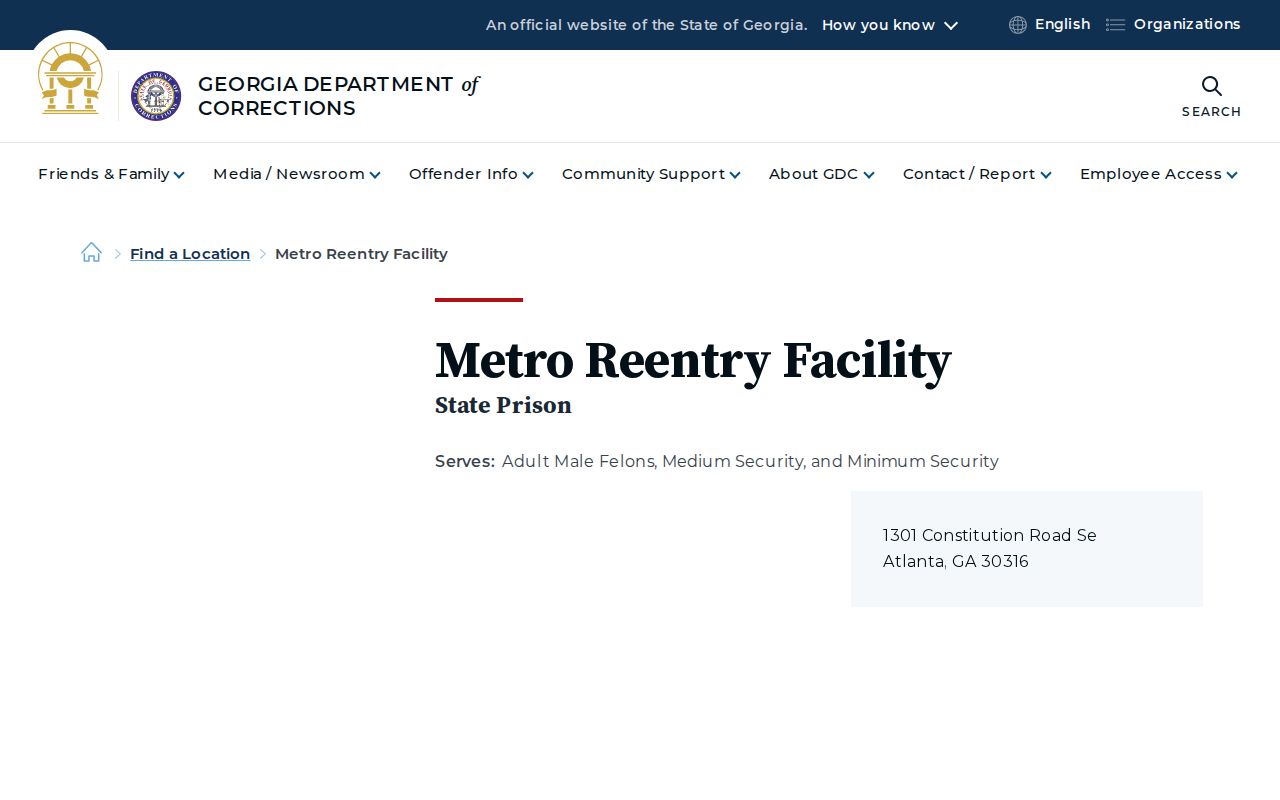
GDC lists Metro Reentry Facility at 1301 Constitution Road SE, Atlanta, Georgia 30316. The research identifies it as a state prison serving adult male felons at medium and minimum security. No facility phone number was established in the supplied research, so the GDC location page and the department’s main contact are the supported routes for current contact details.
The official Metro Reentry Facility page is the source for the facility view shown below.
For a named-person county search before a documented GDC handoff, the Fulton County release search and records guide explains how the county booking record identifies transfers to DOC. Once that handoff appears, GDC becomes the controlling custody source.
Metro Reentry Federal Detainers
An order or detainer from another agency can change where a person goes after leaving GDC custody. A detainer is a request that the holding agency keep or transfer a person for another authority. Fulton release research has a federal layer because FCI Atlanta has both BOP and ICE detention information. That does not mean every Metro Reentry record involves federal custody.
If a record or court file identifies an ICE or federal handoff, use that named system. BOP covers sentenced federal inmates; ICE uses its own Online Detainee Locator System; federal pretrial custody may run through a federal court and the U.S. Marshals Service. Do not infer a federal transfer solely because a state facility record disappears.
Metro Reentry Facility Context
Fulton custody spans the main county jail, several annexes, contract beds, state institutions, and federal systems. The Department of Justice report maps the county jail and its annexes, but Metro Reentry Facility sits outside that county jail group. Its presence in Atlanta does not change its GDC status. This local map helps prevent a common error: treating every detention address in Fulton County as part of one sheriff roster.
Use the agency named on the record. A Fulton release type such as “Transferred to DOC” marks the county-to-state handoff. A GDC status and release field then describe the state stage. Parole and DCS sources add the post-release layer only when the record supports it.