
Atlanta Transitional Release Paths
Atlanta Transitional Center is a Georgia Department of Corrections transitional center for minimum-security offenders. It is not a Fulton County jail annex. The legal custody, sentence information, movement history, and discharge path belong to the statewide GDC system. Fulton booking data may document an earlier county case, but it does not confirm release from this center.
A person may leave for parole, reach a sentence maximum and discharge, move into another approved status, or transfer to a different GDC location. Parole is conditional release before the sentence fully ends. Discharge or max-out means the custodial sentence has reached its end, though a separate court order can still matter. A facility transfer is not release. The current location and status fields must be read with the sentence and parole information.
Confirm an Atlanta Center Release
Start with GDC Find an Offender. Search by GDC ID when known because it is more precise than a name. Otherwise use the full name and available identifying details. Open the matching result and compare current status, most recent institution, sentence fields, and any release or parole information shown. Do not use the Fulton sheriff roster for this state placement.
- Search GDC by ID or full name and verify the identity.
- Review status and institution to distinguish custody from a completed stay.
- Check the Georgia Parole Board's parolee and tentative parole month tools when parole is possible.
- Contact DCS when the person appears to be under community supervision.
- Submit a focused GDC open-records request if the public fields do not establish discharge.
The Fulton post-release supervision guide explains the separate roles of parole, probation, and DCS. A projected or tentative date is not proof that release occurred.
Atlanta Center Search Fields
GDC research shows that the offender query supports searches by case number, GDC ID, first name, last name, gender, race, age range, most recent institution, primary offense, conviction county, active-or-inactive status, and sentenced-most-recently range. Broad searches can return many people. Use several stable identifiers and confirm the most recent institution before relying on a record.
| GDC item | What it answers |
|---|---|
| GDC ID | Identifies one state corrections record. |
| Status | Helps separate active and inactive records. |
| Most recent institution | Connects the person to Atlanta Transitional Center. |
| Sentence fields | Provide the state sentence context. |
| Parole information | Shows parole-related timing or status when published. |
A stale or incomplete public result should lead to GDC records, the Parole Board, or DCS, not to a guess that the person has been released.
Atlanta Center Records Contact
GDC lists Atlanta Transitional Center at 332 Ponce De Leon Avenue NE, Atlanta, with a facility phone and fax. Facility staff can route current operational questions, but public release or discharge documentation may require the GDC Open Records Request portal. Give the person's GDC ID, full name, date of birth if known, facility, and approximate departure date. Ask only for existing public release, discharge, movement, or sentence fields.
Atlanta Transitional Center
332 Ponce De Leon Ave. NE
Atlanta, GA 30308
Phone: (404) 206-5103
Fax: (404) 206-6582
GDC legal-services guidance states that institutional and central-office files are confidential under O.C.G.A. Section 42-5-36. That limit does not make every public status field unavailable, but it means a request should be narrow. Georgia's Open Records Act also does not require an agency to create a record that does not exist.
Atlanta Transitional Center Profile
The official GDC facility page identifies the center and its role in the state corrections system.
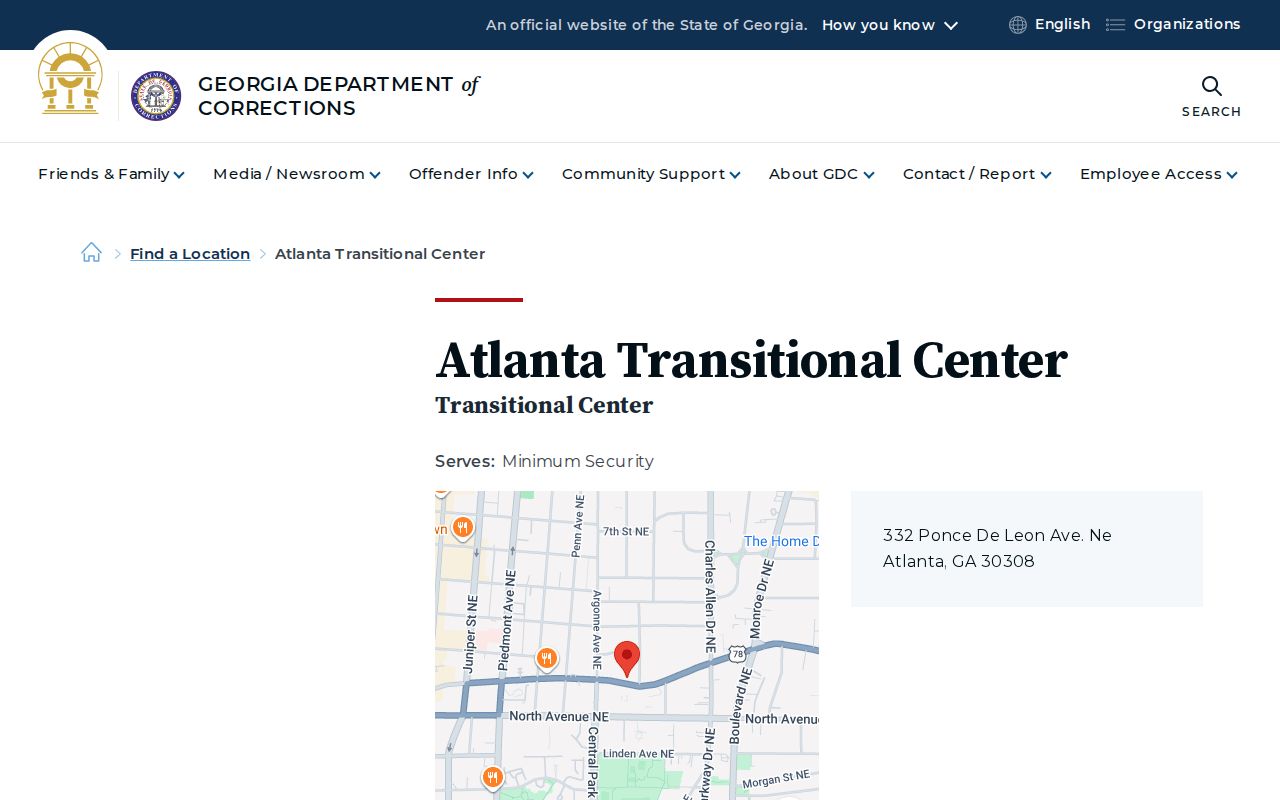
The facility listing supplies the authoritative address, contact details, security level, and population served, while offender-specific release facts remain in GDC and parole records.
Transitional placement does not itself mean that a person has discharged the sentence. Minimum security describes the setting, not a final custody result. A person can still be an active GDC offender while preparing for return to the community. That is why the offender record and parole status are stronger evidence than the word transitional.
Parole and DCS Verification
The State Board of Pardons and Paroles controls parole decisions. Its tools can show parolee information and a tentative parole month, often called a TPM. Tentative means subject to change. The Board may alter the timing, and release is not final until it occurs. A parole result therefore needs a current status check.
DCS supervises parole and probation in the community. The Atlanta Field Office serves Fulton and the Atlanta Circuit at 276 Memorial Drive SW, Atlanta, GA 30303, Monday through Friday from 8:00 a.m. to 4:30 p.m., phone (404) 463-0410. DCS can route supervision questions when public information indicates the person was released under supervision. It is not the source for an institutional discharge record.
Atlanta Center Facility Context
Fulton's larger facility map can confuse county and state custody. DOJ describes a Fulton jail system with a main jail and annexes. Atlanta Transitional Center is outside that county-jail structure even though it is in Atlanta. The GDC facility listing, offender query, Parole Board tools, and DCS office are the proper chain.
This distinction also protects against a false release conclusion. Disappearing from a county roster may mean the person entered GDC custody. Leaving the center may mean transfer to another GDC facility. Only the state record can show that sequence. Court records may explain the original sentence, while GDC records show how state custody was carried out.
Atlanta Center Federal Release Holds
A GDC departure can still lead to another authority. If a public record names a federal or immigration detainer, check the receiving system. BOP uses its Inmate Locator for federal custody. ICE uses the Online Detainee Locator System and publishes a contact for detainees held at FCI Atlanta. Callers should have an alien registration number and country of birth, or useful biographical details.
Do not make an ICE or federal check without facts pointing to that route. The practical rule is narrower: a release from GDC is not necessarily a release from all legal custody when a detainer or transfer exists. Confirm the handoff with the system that received the person.
For ordinary state release verification, compare the dates on the GDC record with the Parole Board result and any DCS supervision start. If the dates do not align, ask the office that owns the disputed field. GDC can address state custody and discharge records. The Board can address parole action. DCS can address active community supervision. A court clerk can supply the sentencing order. This division of responsibility is more reliable than asking the transitional center to interpret every part of the sentence.
Atlanta Center Release Reconciliation
Compare the actual dates across the GDC result, parole record, and DCS supervision record. Each agency owns a different step. GDC can confirm institutional movement or discharge. The Parole Board can explain a parole decision or tentative parole month. DCS can confirm the office that supervises a person after release. A court clerk provides the sentencing order. No single office should be asked to interpret all four records.
Keep the GDC ID, most recent institution, and date checked with each inquiry. If Atlanta Transitional Center is no longer listed, determine whether the replacement is another GDC institution or an inactive status. A changed facility is not proof of release. If public fields conflict, a narrow GDC request for existing public movement and discharge fields is the sound fallback.
Projected dates also require care. A tentative parole month is a Board planning point, not an executed release. Sentence calculations may change with credits, disciplinary action, court orders, or a parole decision. Use the current state record and ask the owning agency about a date that changed.
After actual parole, DCS can route supervision questions through the Atlanta Field Office. Probation is ordered by a court and differs from parole, which the Board grants after a prison sentence begins. Discharge is different from both because it marks the end represented by the custodial record. Define the result before selecting the office.
If the GDC public page lacks an exact release field, request existing public confirmation through its portal. Ask for a date, status, most recent institution, and public movement or discharge fields. Institutional files can remain confidential, so a focused request is more likely to receive a useful lawful response than a demand for the full file.