
North Annex Release Destinations
Alpharetta Jail is identified as the North Annex of the Fulton County Jail system in the U.S. Department of Justice findings report. The official Share Fulton booking dataset also uses Alpharetta Jail as a location value. Those two facts matter because a location change is not the same as a release. Someone missing from a Rice Street search may still be housed at this annex, at another Fulton location, or in an outside bed.
A completed Fulton booking record may show release to bond, time served, probation, another agency, the Georgia Department of Corrections, a program, or another destination. The ReleaseDate and ReleaseType fields give the first clue. A transfer closes one phase of Fulton custody but does not prove the person entered the community. When the type names another agency, continue with that agency before treating the event as a full release.
Confirm an Alpharetta Jail Release
Use the official county sources in sequence. Search the Fulton public inmate database for active custody, then check the Share Fulton Jail Bookings dataset for a matching past booking. The sheriff says its inmate database is updated once daily, so a recent move or release can take time to appear. Match by full name, booking number, booking date, and date of birth when it is available. Names alone can produce the wrong person.
- Check the FCSO inmate search to see whether the booking is still active.
- Search the county booking dataset and identify the row whose location is Alpharetta Jail.
- Read the release date and release type together, not as separate proof.
- Check the relevant Fulton court docket for a bond, dismissal, time-served sentence, or other order.
- Use Fulton VINE for a custody-status check or notification, then contact FCSO if the sources conflict.
The broader Fulton County released-inmate search explains the county record fields and records-request route. Current custody belongs in the sheriff search. Past release belongs in booking data, court records, or a public-record response.
Alpharetta Release Data Fields
The public dataset is useful because it preserves more than a yes-or-no status. It can connect the annex location to the booking event, the agency that delivered the person, and the manner in which the booking ended. Read the row as a set.
| Field | How it helps |
|---|---|
| BookingNumber | Separates people with the same name and ties related entries together. |
| BookingDate | Identifies the custody episode being researched. |
| Location | May display Alpharetta Jail for the North Annex. |
| ReleaseDate | Shows when Fulton recorded the end of that booking phase. |
| ReleaseType | Distinguishes bond, time served, transfer, probation, and other outcomes. |
| DeliveryAgency | Helps route follow-up to the arresting or delivering agency. |
The official Alpharetta Jail booking-data view shows how these records are returned.
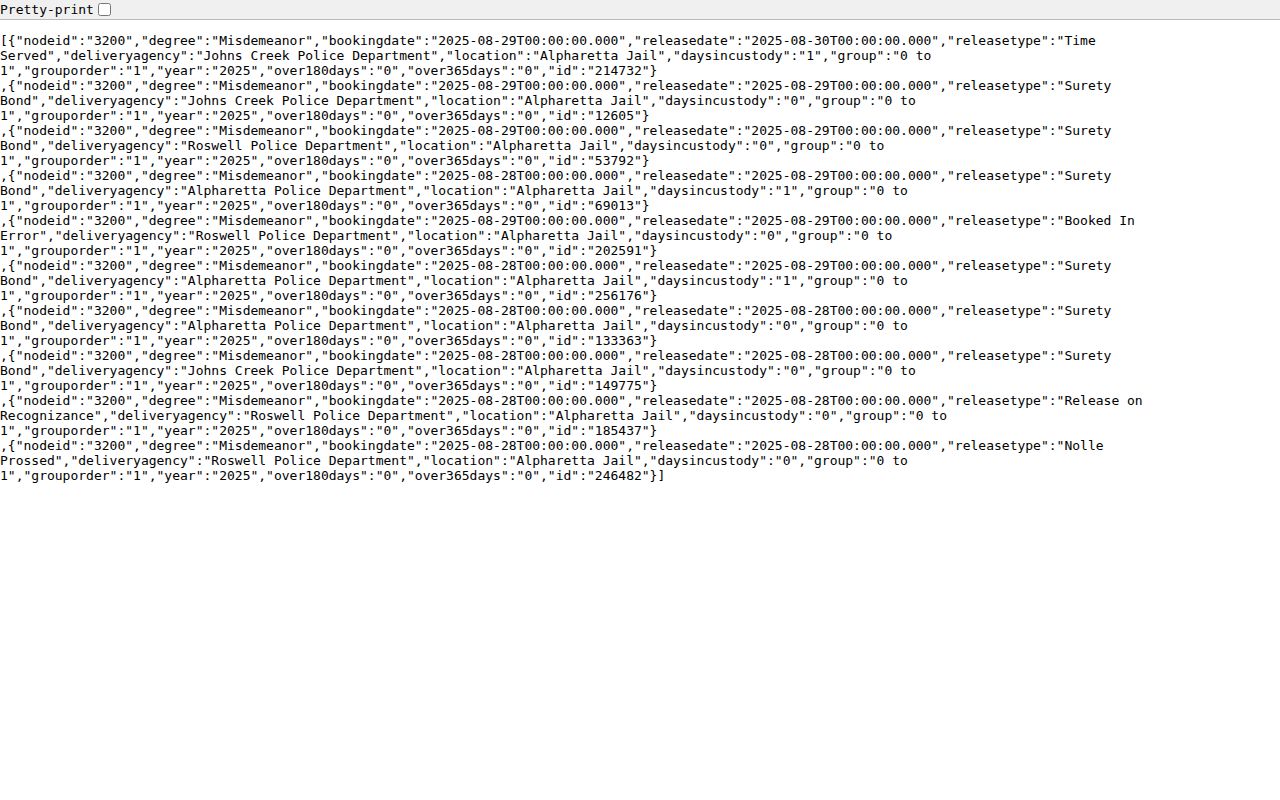
The screenshot demonstrates the location filter, but each result still needs identity and custody checks before it can confirm a specific release.
Request North Annex Records
When the dataset lacks enough context, ask the Fulton County Sheriff's Office for existing public booking and release records. A narrow request should give the full name, booking number if known, date of birth if known, and an approximate booking or release date. Ask for the booking date, release date and time, release reason, facility, public transfer destination, and any public court-order reference. Do not ask the office to create a certificate that does not exist.
Georgia's Open Records Act, O.C.G.A. Section 50-18-70 and following sections, governs this route. Section 50-18-71 generally calls for records within a reasonable time not over three business days when they exist and are available. If more time is needed, the agency should describe the records and give a timeline. Copying, search, retrieval, and redaction costs may apply, so request an estimate before charges are incurred.
Fulton County Sheriff's Office
185 Shirley C. Franklin Blvd. SW
Atlanta, GA 30303
404-612-5100
North Annex Facility Mapping
The DOJ report's facility map names the main jail and annexes, including South Fulton/South Annex, Alpharetta/North Annex, and Marietta Annex. This is the key local distinction. A Fulton detainee may move among those places while the same county booking remains relevant. The public dataset likewise includes several facility labels. It is safer to reconcile them than to rely on one address.
Check the booking location on the date in question, then compare the active inmate result and release fields. If a court order appears but the roster has not changed, processing may still be underway. If a release date appears with a transfer type, continue to the receiving system. The map prevents two common errors: declaring release because Rice Street no longer lists the person, and declaring continued custody because an old booking row remains public.
Federal Handoffs After Release
A Fulton release can be a handoff. If the record says transfer to another agency, determine whether the destination is county, state, federal, or immigration custody. The GDC offender search covers a person received into state corrections. The BOP Inmate Locator covers federal inmates from 1982 onward. ICE uses its own Online Detainee Locator System.
ICE also publishes an FCI Atlanta detention contact. A caller asking about a detainee there should have an alien registration number and country of birth, or enough biographical detail to identify the person. This check is relevant only when the record or known facts point toward immigration custody. It is not a general annex-release search. A Fulton handoff confirms the local phase ended, not that every custody hold ended.
Note: A transfer date can close Fulton custody while another agency continues confinement.
North Annex Release Court Proof
Court records can explain why a release type appears. Fulton routes criminal matters among Magistrate, State, and Superior court systems. First appearance and preliminary issues may begin in Magistrate Court, while the charge later proceeds elsewhere. Search the docket tied to the case rather than assuming one court contains every event.
Useful entries include bond orders, sentencing orders, dismissal or nolle prosequi entries, probation orders, and final dispositions. A time-served outcome may also reflect credit for days already confined under O.C.G.A. Section 17-10-11. The jail record shows the custody event. The court file often supplies its legal basis. Together they provide a firmer answer than either source alone.
VINE adds a separate status channel. Fulton Sheriff's jail page identifies GA Fulton VINE for telephone or internet custody checks and notification registration. A VINE update can help confirm that a status changed, but it may lag the source agency and does not explain the court reason for release. Use it with the booking number and court file. If a public record later becomes restricted or sealed under Georgia law, some public-facing results may disappear. That absence does not prove the booking or release never occurred. The clerk or originating agency can explain current public-access limits without disclosing protected material.
North Annex Release Cross-Checks
A complete North Annex check should reconcile time as well as identity. The sheriff's current-inmate database is updated once per day, while the public booking dataset is a separate system. A court order may arrive before either public view changes. Record the time each source was checked and avoid treating a short delay as proof of either custody or release. If the person is still shown as active after a release order, FCSO can explain whether processing, a warrant check, or another hold remains.
Release type controls the next step. Surety or cash bond points toward the bond and court records. Time served should be compared with the sentencing entry and credit for time already confined. Probation points toward the court's probation order and DCS when state community supervision applies. Transfer to GDC requires the statewide offender search. Transfer to another agency requires the receiving agency's official custody source. Extradition calls for the demanding jurisdiction. These routes are distinct even when the same Fulton row supplies the starting release date.
Use stable identifiers through every check. A booking number ties the Alpharetta location to one custody episode. A case number ties that episode to the court file. A GDC ID, BOP number, or alien registration number belongs only in the receiving system where it applies. Keep those numbers separate. A shared name or similar date is not enough to merge two records.
Public access may narrow later. Georgia record restriction under O.C.G.A. Section 35-3-37 can remove eligible material from public-facing criminal-history results, and sealed court records have their own access rules. Juvenile, medical, victim-identifying, and other confidential records may also be withheld. Ask the clerk or originating office what public record remains available. Do not infer that a missing result proves no arrest, no North Annex stay, or no release. The sound conclusion is limited to what the current official sources confirm.