
Fulton County 72-Hour Release List
The main jail is the central intake point for Fulton bookings. The Sheriff's jail information says an arrested person is first brought here for property intake, a medical screen, fingerprints, a photograph, and a warrants check. A completed booking can end in bond, time served, probation, transfer to the Georgia Department of Corrections, transfer to another agency, a program move, extradition, or another coded result. Those outcomes are not interchangeable. A release to the community ends confinement, while a transfer ends only Fulton custody.
The official Share Fulton record uses a release date and release type to describe that change. It also identifies the booking location, booking number, delivery agency, charges, bond details, court information, and days in custody when those fields are present. A family member trying to meet someone should confirm both the stated release type and the destination. Court orders and holds can affect the final result even after a bond or sentence event appears complete.
Check Fulton County Three-Day Releases
Begin with the Fulton County Jail Bookings dataset. Its description states that it holds a record for each booking into a Fulton detention facility since January 2014 and includes release date and reason when a person has been released. Search by the full name, then reconcile date of birth, booking number, booking date, and location. Similar names can otherwise lead to the wrong event.
- Find the booking that matches the person and arrest episode.
- Read
ReleaseDate,ReleaseType, andLocationtogether. - Compare the FCSO inmate search, which concerns current custody and is updated once daily.
- Check the applicable Fulton court file for bond, sentence, dismissal, or transfer action.
- Use Georgia VINE or request the booking and release record when the online fields conflict.
The broader Fulton County released-inmate search covers a named person, while 24-Hour Releases narrows the range for same-day checks. A state-prison transfer belongs in GDC Find an Offender, not merely the county roster.
Fulton 72-Hour Release Fields
The official API can sort all Fulton release records newest first. Open the Share Fulton descending release query to inspect the source before applying a three-day date boundary.
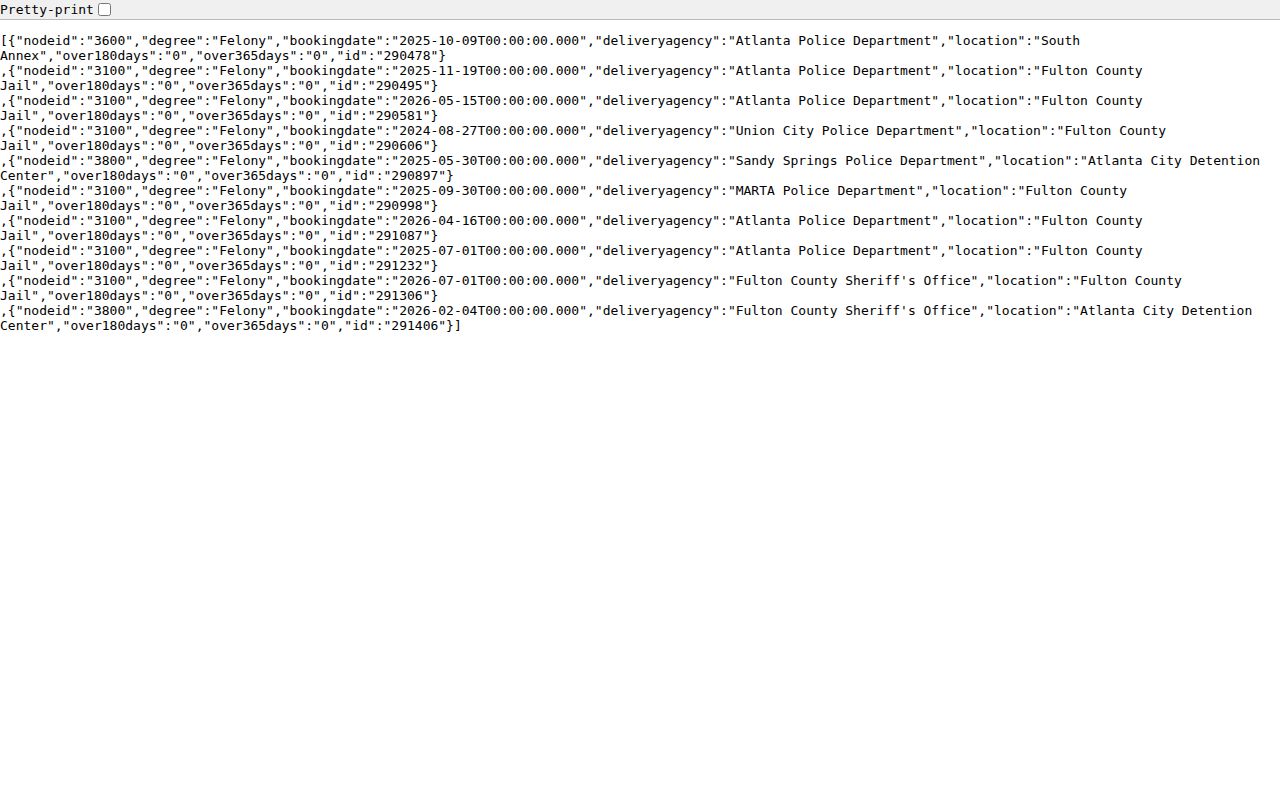
The captured descending view makes recent dates easy to identify, but a reader must calculate the three-day boundary and check for posting lag.
| Field | Use |
|---|---|
| ReleaseDate | Date and time recorded for the end of this Fulton custody event |
| ReleaseType | Bond, sentence, transfer, probation, extradition, or other coded reason |
| Location | Main jail, annex, city center, or another listed placement |
| Booking Number | Key for matching records and requesting the correct file |
| DaysInCustody | Dataset measure tied to the booking episode |
Fulton Three-Day Release Fallbacks
When a public row lacks needed detail, ask the Fulton County Sheriff's Office for the booking and release material tied to the exact booking number. Georgia's Open Records Act provides the request framework, though protected details can be withheld. Give the person's full name, date of birth if known, arrest or booking date, booking number, and the precise fields sought. A narrow request is easier to identify than a request for every file bearing a common name.
Fulton County Jail
901 Rice Street NW
Atlanta, GA 30318
404-613-2000
The main front desk is open 24 hours daily. The jail page separately lists 404-613-2002 and 404-662-3516 for newly arrested people and bond information.
For formal records routing, the FCSO contact page lists the Sheriff's Office at 185 Shirley C. Franklin Blvd. SW, Atlanta, Georgia 30303, and 404-612-5100. Ask the originating court for its order rather than asking jail staff to interpret a case outcome.
Georgia VINE adds a person-specific custody and notification route. FCSO lists GA Fulton VINE at 877-994-8463, while the statewide Georgia VINE source lists 1-833-216-6670. A notice can help flag a status change, but it should be reconciled with the written release type and court record. For a state-prison transfer, use GDC Find an Offender instead of extending the county date window.
A formal records request is the fallback when public fields are incomplete. Provide the full name, date of birth if known, booking number, booking date, and the precise release fields sought. Georgia Open Records Act timing and lawful limits apply. The originating court remains the source for the order behind bond, sentence credit, dismissal, or probation.
Note: The jail phone may confirm a routing point, but the written booking record is the stronger source for the recorded release type.
Fulton Weekend Release Window
The Fulton jail system extends beyond Rice Street. The U.S. Department of Justice findings report identifies the main jail with South Fulton or South Annex, Alpharetta or North Annex, and Marietta Annex. The Sheriff also lists Marietta Annex and Atlanta City Detention Center contacts. Share Fulton location values include those sites plus out-of-county placements.
This map matters after a release inquiry. A person can leave the main building yet remain under Fulton authority in an annex or contract bed. Search the booking history by identity and number, not just by the place a caller last knew. If the location changes with no release type, treat it as movement. If a release date is paired with transfer to another agency, locate the receiving system before assuming the person can be met in the community.
A weekend range should be built from calendar dates, then checked against the actual timestamps in each returned row. Saturday and Sunday arrests can reach first appearance on Monday under the process described by FCSO, so a Monday check may mix releases tied to several different court sessions. Holidays can create a similar catch-up pattern, though the research gives no fixed holiday posting schedule. Do not promise that every release will appear within exactly three days.
When a row shows bond, time served, probation, dismissal, or a release order, the court file may explain the event. Transfer codes require a receiving-agency check. Location values also matter because Rice Street, Marietta Annex, South Annex, Alpharetta Jail, Atlanta City Detention Center, and out-of-county placements can all appear in Fulton data.
What if the booking says “Out of County”? It describes a placement in the Fulton data, not a separate public release list. FCSO records may be needed to identify the receiving agency.
Fulton 72-Hour Transfer Checks
Fulton release research must account for immigration and federal handoffs. A detainer is a request or hold from another agency. It can cause a person to leave county custody without becoming free. Start with the county release type. Then use the receiving system supported by the record or court file.
The ICE Online Detainee Locator accepts an alien registration number and country of birth or biographical search details. ICE also publishes an FCI Atlanta detention contact page. It tells callers seeking detainee information to use 404-893-1290 and have the registration number and country of birth, or the person's name, aliases, birth date, and country of birth. A federal criminal transfer may instead require the BOP locator or federal court docket.
Note: A Fulton release date closes the county event; it does not erase a state, federal, immigration, or other county hold.
Why Fulton 72-Hour Data Lags
Fulton does not publish a labeled rolling 72-hour roster. The July 15, 2026 research snapshot found the latest release date at July 13 while the latest booking date was July 14. A three-day query from July 12 returned 66 rows, split between July 12 and July 13, while a literal last-day query returned none. That mismatch is a source-update issue, not proof that no one left custody.
Release processing can take time after legal eligibility. The Sheriff's jail page says timing is affected by the number of arrestees and the availability of state and national database information. Staff must complete checks and administrative steps before a person leaves. A database row may also lag a real-world event, while the current-inmates snapshot reflects roughly the prior evening rather than a live doorway count.
Use more than one timestamp. Compare the court action, recorded release date, roster update, and any VINE notice. Georgia VINE offers custody-status checks and notifications, but an alert is a supplement, not the official release document. If pickup plans are time sensitive, call the facility and avoid treating a projected hour as guaranteed.
- Release
- The end of a specific custody event, whether to the community or another legal status.
- Transfer
- Movement to another facility or agency while custody continues.
- Detainer
- A hold or request that may prevent community release.
- Discharge
- Completion of a sentence or supervision obligation, depending on the record.
Public Record Search
Sponsored Results